Showing posts with label Dance-Related. Show all posts

Tuesday, June 6, 2017

A Tuesday Rant About E-mail Scammers


Well, that was a fun to way spend my morning.

I just sent a complaint report to usa.gov about an e-mail scammer who's been contacting me.  I'm still feeling irritable about it, so I decided to write a post and vent my feelings a little.  Here's my story:

As many of you know, I'm a self-employed ballroom dance teacher.  I have my own studio and my own website.  And I love my job.

The one sucky thing about my job is that it's based on appointments and walk-ins, so I have good months and bad months with earnings.  I have to hope that people will use my website's contact form and inquire about private lessons.

So you can imagine how happy I was when a "father" e-mailed me the following message last week:

"Hello how you doing today this is Nicolas Barry i will like to ask if you still provide dance lesson I'm organizing a surprise dance (like flashmob) for my daughter's wedding, So i want you to teach the Bridesmaids choreography and i hope you accept credit card as method of payment ?"
Mind you, this isn't a weird e-mail for me.  People are frequently grammatically incorrect in e-mails, and I get a lot people asking me if I accept credit cards.  What was different was this surprise flash mob dance request; I've never had a request like this before, but hey!  I'm always up for something new!

I replied with my usual response: yes I do still teach dance lessons, yes I do accept credit card.  I also added the usual "private group lessons are $15 per person per hour.  Please let me know if you wish to set up an appointment".

So then I got this response:

"Thanks for the response. Wedding is on the 24th of June. The ladies are local. There are 7 Bridesmaids(all ladies) and i want them to choreograph a song by "John Legend" titled "All of me"  I want lessons to be at your studio. I'll prefer Tues&Thurs 11-1pm, if that's okay with your schedule. Though the ladies are fully committed to this training, so their timing is pretty flexible  They are not professionals and have no experience in dancing. What is the total cost for 2 hour rehearsals twice a week for 3 weeks?"

Uh, okay.  It's still pretty legitimate-looking.  Wedding date, number of bridesmaids, song, schedule, etc., all the usual info.  The last line was a little weird, but I figured he just wanted confirmation on the cost.

So I replied in the usual way, repeating the cost and that it's all pay-as-you-go.  The e-mails went back and forth, with the guy really sounding like a dad wanting to surprise his daughter, but he still insisted on my quoting an estimate.  I finally conceded and gave him a number: $1,260.  I also emphasized the pay-as-you-go policy with the payment at the end of the lesson.

Here was his next response, and that's when the red flags came up:

"What is your full-name,studio address for the private transport driver i'm organizing to locate your place when they are coming Can i make reservation with my credit card? Cause i won't be coming in with the ladies due to my current health status. I'm currently under intensive care in preparation for my surgery. I'm doing the booking since the whole surprise is my idea and i will be responsible for all payment."

Seriously, he used my website for the original e-mail, he should be able to see all the basic info right there!

The real kicker was the "private transportation".  I've gotten this kind of e-mail scam before.  They say they're hiring transportation and, for some emotionally tragic reason, they have to pay for all the lessons in advance by credit card.

Here's how they get you: the driver can't accept credit cards so they ask you to put his charges in along with your lesson cost.  They expect you to be helpful and agree, and when the lesson happens, you give the driver his price using your own cash.  Once they're gone they reverse the credit card charge and run off with your money.  Sucks, doesn't it?

I sent him a reply calling his bluff.  I told him there were no reservations allowed, and that if paying per lesson was a problem, that he should send the bridesmaids money and they could pay me in cash.  I also threw in the friendly advice that he should make sure his driver is paid in advance.  I then subsequently reported his email to usa.gov.

I know I probably shouldn't reply, but he tried messing with me and I really, really want to get a little revenge.  If he keeps replying, I think I'll try suggesting something a little more ridiculous.  I'm not sure what yet, maybe suggest that the choreography should include life-size Dalek robots from Doctor Who?

I'm still miffed, though.  It had seemed so legit at first, and I would have made so much extra cash this month if it was real.  It angers me that there are people out there who are willing to steal money from innocent small businesses who only make enough to get by, and wouldn't have been able to afford losing hundreds of dollars.  The world can really suck sometimes.

Anyway, here's some helpful advice for all you dance studios out there: watch out for e-mail scams like this one.  Never accept a charge where you have to pay for another service with your own money.  Report it immediately if you spot this type of scam.  The bridesmaid flash mob has been the most recent one, but there are other scams are out there as well.  They are all grammatically incorrect, need a bunch of lessons prepaid, insist on a check or credit card for some compassionate reason, and have weird requests added on (paying for someone's boarding, transportation, etc.).

Done for now.  I'm going to take my mind off things and go get lost in a book.

Tuesday, January 6, 2015

Tuesday's Opinion: My Top Ten Pet Peeves When Ballroom Dancing


Hello everyone!  I haven't posted anything about dancing for a while, so I figured I post something now.

As most of you know by now, I'm a ballroom dance teacher.  I have a whole lot of dance experience, both positive and negative.  So I've decided to post:

My top pet peeves when ballroom dancing


Tuesday, August 19, 2014

Tuesday's Opinion: The Benefits Of Dance Shoes and How To Buy Them

A dance-themed opinion today!  This week:


 Ballroom Dance Shoes

I often get these two questions when I teach new students:

1) What kind of shoes should I wear?

and

2) Should I get special dance shoes?

Dancing, like any other physical activity, requires certain equipment to keep you comfortable for extended periods of time.  With the clothing, there's nothing to worry about: you simply wear something practical that you easily move around in, be it casual or fancy.

But when it comes to shoes, that's a completely different story.

To beginner dancers, I tell them not to worry about buying new shoes; there's really no need for dance shoes when all you're doing are the basics.  Just wear something you already have at home. 
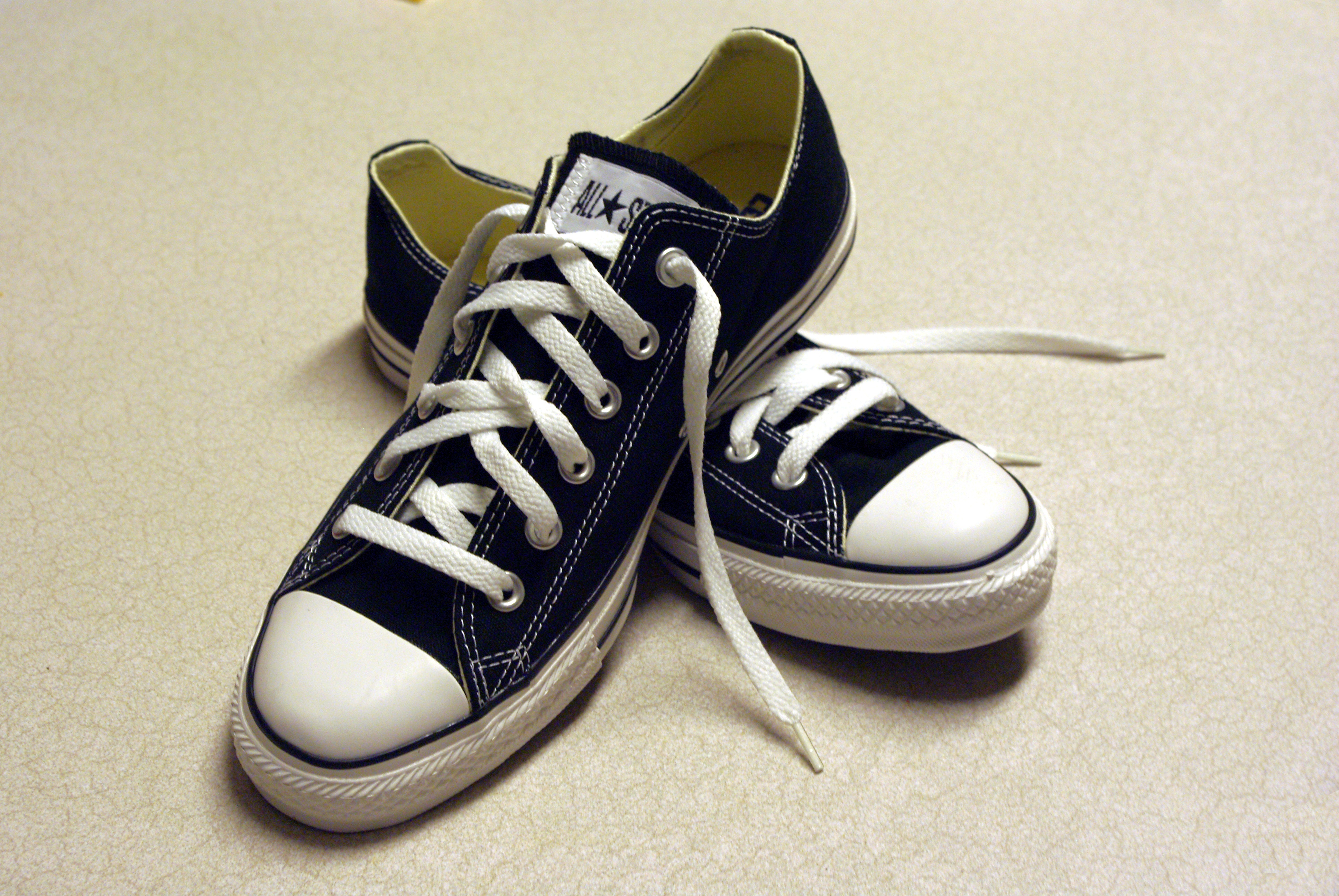
Sneakers and dress shoes work pretty well
The best non-dance shoes to wear is something light and comfortable that won't easily slip off the foot.  Ideally you'd want something with a smooth and slippery bottom.  Dress shoes work really well, and so do sneakers, although sneakers tend to grip the floor a little too much, which can making turning difficult.


Avoid clunky shoes and flip flops!
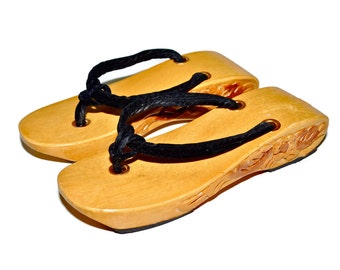
Avoid heavy boots or anything with a rubber sole that can leave black marks on the floor. And especially avoid flip flops or clunky shoes.  I cringe every time I see flip flops on the dance floor; they mean difficult and clumsy dancing ahead with that person.  I remember a dancer coming in to our intermediate class once a few years back, wearing wooden thong sandals, with a thick and heavy 2-inch heel.  Pretty sandals, but man!  We were dancing cha cha, which involves lots of steps, and you could hear those clunky sandals for the entire lesson.  CLUNK! CLUNK-CLUNK-CLUNK! CLUNK-CLUNK!  What was worse, the shoes were inhibiting her ability to dance, so the timing of her clunking was completely off, and her steps were clumsy and slow.  She might have done all right if she had taken those shoes off, but she ended up having an unnecessarily difficult time instead.  Let this story be a word of warning to all dancers: Wear... Appropriate....Shoes!


With that being said, what's the big deal about dance shoes?  Well!

Technique is crucial the more advanced you get
In the beginning dance shoes aren't necessary: you're too focused on learning the basic moves to concentrate on technique.  But the more advanced you get, the more important technique becomes.  And when I say technique, I mean that you must become more comfortable with keeping your weight forward on the ball of your feet.  You use the ball for turning and for balance; your steps will not feel good or even look good if you don't rely on that part of your foot.

You need to be able to point your toe
Good technique also involves the ability flex and point your toes, and maintaining
constant contact with the floor in some way shape or form, be it a slight brush with your toe, or a full step that takes your weight.

All this technique is virtually impossible to do in a regular shoe.  Regular shoes have thick, inflexible soles that are frequently meant to grip the floor.  They are made for walking, or for appearances, but certainly not for dancing.
Dance shoes are built specifically for dancing.  They are meant to endure constant, prolonged movement.  They are flexible, with thin suede soles that allow for ease of turns and the ability to feel contact with the floor.  By wearing dance shoes, you can not only apply good technique to your steps, but you also are more aware of how well you're applying your footwork, therefore allowing you to advance and improve your dancing.

Never had to resort to this!
Have I mentioned yet that dance shoes are comfortable?  They're built for endurance as well as flexibility, so you're able to dance the night away!  You can even last a while in 3-inch heels!  Because of their comfort, I've gotten into the habit of wearing dance shoes at weddings; as a result I am usually the last women still wearing her heels at the end of the night.

So, to answer the two questions I wrote at the beginning of this article, yes, you should get dance shoes, but only if you're starting to go beyond the basics and are interested in improving your dancing.  If you're only just starting you shouldn't worry about it, but instead wear comfortable shoes that aren't heavy, grippy, or clunky.

Now, once it's been decided that my students are going to get dance shoes, I frequently get this follow-up question: what kind of dance shoes should you get and where can you get them?  So here's a little extra info for you to help you find the right pair for you:

Kinds Of Shoes:
shoes that bend like this have no arch support
First off, make sure it's ballroom dance shoe.  There are some ballet and jazz shoes out
there that resemble ballroom shoes, but really aren't.  A ballroom dance shoe is generally made of leather, and contains a steel half-arch that allows you to point your toe without losing your arch support.  Ballet and jazz shoes are split-soled and can fold in half easily,  thus they have no arch support .  Avoid those.
Some people prefer to use dance sneakers for dancing and I admit I'm one of them; they're great for a long night of Swing dancing.  But I don't recommend using them all the time.  Dance sneakers either have too much flexibility (Jazz) or too little (general).  They also tend to be cumbersome for any dance other than swing.

Some people prefer dance sneakers

There are three types of ballroom shoes: Standard, Latin, and Practice. 
Men's standard

Standard is what the guys typically wear; they look like black dress shoes.  For the ladies, standard is a closed toe shoe with a heel that's meant for traveling backwards; they're ideal for the smooth dances, such waltz and foxtrot.

Ladie's Latin


Latin shoes for the ladies are open-toed sandals with a 1- to 3-inch heel.  They're perfect for Latin dances such as Rumba and Salsa, but they also work great for all the other dance styles.  If you're only getting one pair, I would recommend a Latin shoe.

Practice Shoes
For the guys, a Latin shoe means having what's called a Cuban Heel-- a 1.5-inch heel that's only really used in competitions.  I recommend just getting a Standard shoe instead.

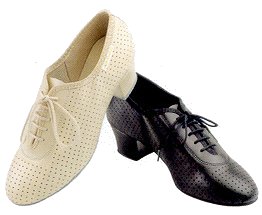
Practice shoes don't look or feel any different for the guys, but for a ladies' shoe, it means something with a low heel that kind of resembles a man's standard shoe, but with a more flexible outside.  These shoes are practical and comfortable, and are great for Swing and general dancing.


Brands And What To Look For:
When you go shopping for dance shoes, you are mainly looking for comfort and ease of movement.  A ballroom shoe should feel snug, like a slipper.  The toes should be flush to the edge, and your foot shouldn't slide around inside.  A good rule to follow is to select a shoe that's at least half a shoe size smaller than what you would normally wear.

For a ladies' high-heeled shoe, there should be enough cushion in the front to keep you comfortable.  If you're trying on a shoe and it feels really hard right off the bat, don't get it.  A good high-heeled shoe shouldn't make you feel like you're wearing high heels; it should feel natural.


There are many different shoe brands out there, and you should pick the one you like best.  For myself, there are three brands I like:


1) Very Fine Dance Shoes: This is my go-to brand, and ideal for those who are buying shoes for the first time.  They're cheap for dance shoes ($60-$100), but they're easy to break in, and come in a wide range of options, including customizable options.  They don't last very long, however.  As a teacher I end up destroying them in a matter of months, but for the average dancer they might last for a good couple of years
2) Stephanie Dance Shoes: I've tried this brand about once or twice, and they're pretty decent.  Like Very Fine, they're a cheaper shoe, but they last a tiny bit longer than the other brand.  However, they are also a little more difficult to break in (my pair gave me blisters for a couple of weeks before it became comfortable enough).  But they are decent shoes that are affordable and stay comfortable for hours.
3) Supadance: This is a higher-end brand.  They're more expensive (the cheapest is easily over $100), but they can last for years, even decades.  These shoes were built for competitors, so they can withstand constant abuse.  They are also very comfortable.  My mother, a very experienced dancer, stands by this brand.


Buying A Shoe:
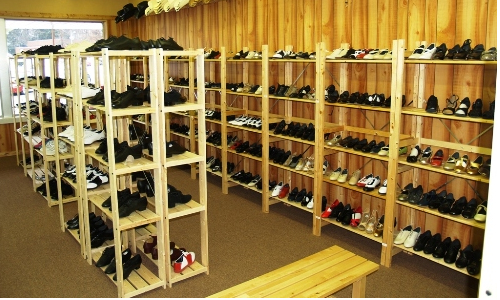
 go to a dance store first
There are two ways to buy a shoe: either online or at a dance supply store.  If it's your first time buying a pair, I would go to a physical store so you can try on different styles, sizes, and brands, with the help of a salesperson who understands what you need.  You will always find a wider range of choices online, however, and frequently at lower prices.  The only problem with purchasing a pair online is that it takes time for the company to deliver it, and you're ordering a shoe without trying it on first, which is always a bit of a gamble.  So when you're purchasing online, make sure you try the shoes on immediately upon delivery, and make sure you try them on soft carpet; carpeting won't scuff the shoes, so if they don't fit well, you can return them and get your money back.

So there you go!  This is quite a lot of information, so I hope it's useful.  If you need more information, or if you need places to purchase some shoes, here are some links:

Places Where I Like Buy Online:
My Favorite Dance Store In Connecticut:

Additional Helpful Websites:

Wednesday, August 6, 2014

Tuesday's Opinions: The Ten Commandments of Dance Etiquette

Tuesday's opinions are a day late, sorry!  But this one required some thoughtful planning.  This week it's danced-themed.


Sometimes in our quest to have a good time, we forget that the people we're interacting with are also trying to enjoy themselves, and our behavior is affecting their ability to have fun.  This is especially true in social dancing.  At every dance event, there is always one person who is some sort of jerk or creep, and who has the potential to ruin your evening, maybe even your ability to enjoy dancing in general. 

These dance irritants are fairly easy to spot if you know what to look for, so listed below I have my 10 Commandments of Dance Etiquette.  These commandments will help you not only recognize those people who could possibly taint your evening, but will also help improve your own reputation on the dance floor

 Of Ballroom Dancing


Commandment I: Dance With Everyone!
And when I say everyone, I mean everyone!  Do not shun beginners or someone who doesn't dance particularly well.  They need to have a good time too.  You need only dance with them for one song.
This commandment also means that you shouldn't monopolize a partner for multiple songs.  Unless this person is your regular dance partner (such as a spouse or intimate other), you should only dance one, maybe two songs with each person.  And if you did come with someone special, dance with them a third of the time, but dance with others as well.  My husband and I have a policy where we dance one song together, and then find other partners for the next 2 or 3 songs, with the only exceptions being a dance that we love doing together.
By dancing with everyone, you show other dancers that you are social, and eager to get onto the dance floor and have a good time.
dance with everyone!

Commandment II:  Be Careful When You Say No
Sometimes, it's okay to say no; you don't know the dance, you're done dancing for the evening, or your feet hurt and you need a break.  And there are the occasional times when you are asked by someone you'd rather not dance with (ie., the jerk or creep).  But you should use "no" sparingly.  Being declined is an uncomfortable, unpleasant experience for dancers.  Plus, if you keep saying "no", then you might become black-listed as a snob or an unsocial dancer.
Another thing when you say "no": if you say "no" to one person, then you shouldn't turn around and say "yes" to someone else.  This is considered rude and makes the person you rejected feel terrible and unwanted, and most of the time, they don't deserve feeling that way.
be careful when you say no--you might offend someone

Commandment III: Be Presentable and Well-Groomed
How you dress for an event is important. If it's a formal event, dress formally.  If it's casual, dress comfortably and appropriately.  You want to wear clothes that are breathable, won't get caught on something, and won't slip and slide into inappropriate areas (such as tight dresses that slide up too easily and show your underwear, or low-hanging pants or sweats).  You also want to wear dance shoes, or at least shoes that resemble dance shoes (no flip-flops!!!). 
You also want to stay well-groomed.  Dancing can make you sweaty and smelly, so make sure you deoderize, and bring an extra shirt if you tend to become absolutely drenched when dancing.  Taking care of your appearance at an event makes your dance partners feel more comfortable dancing with you in general, although there's no need to be perfectly clean and dapper all night.  A little sweat never hurt anyone, but a lot can be a little awkward.
look presentable

Commandment IV: Be Fun, But Not Creepy
In my experience, there's always one guy who's a little creepy to dance with.  One guy kept putting his face too close to mine (like he wanted to kiss me, ick!), another guy kept putting his hands in places that verged on inappropriate (like on my hip, or brushing against my chest, ugh!).  There are also those elderly men who continuously ask the young ladies to dance, the ones that could easily be their granddaughters.  I frequently try to avoid these kinds of dancers, but every once in a while, I find myself dancing a song with them, and while they might not realize that they are being creepy, it's never comfortable.
To avoid being creepy, watch where your hands go, respect your partner's space, and, once again, dance with everyone, not just certain types.  Also, don't assume any romantic intentions while you're on the dance floor.  The dance floor isn't like a bar where you can pick someone up-- people just want to dance and have fun.  That's it!
don't be creepy

Commandment V: Practice Good Floorcraft
When you're out on the dance floor, it's not just you and your partner--it's you and at least a dozen other couples.  Which means you need to watch where you're going.  If you're doing a dance that travels, travel only down the line of dance (counterclockwise around the room). Don't be the salmon the swims upstream.  And if you chose to dance mostly steps that don't travel, stay on the inside of the circle, so that people who are traveling can go around you easily and safely.
As a leader it can be difficult to decide what to do next, but when you are dancing, try to be aware of the other dancers around you, and pick your next move based on the space available.  A good leader isn't the one who does the best, most complicated patterns--it's the one who pays the most attention to his/her surroundings and plans accordingly.
Followers need to pay attention as well.  As a follower, you need to watch the other dancers as well, and make sure that your spins and your arms stay in control without flailing around.  Sure we want our moves to look big, but we also have to make sure our moves don't collide painfully into someone else.  You are also responsible for keeping an eye out for the leader's blind spot.
exercise caution on the dance floor

Commandment VI: Always Apologize
Dancing is never perfect.  There will always be some sort of collision on the floor, but whether it's your fault or not, you should always apologize.  You don't need to stop dancing (never stop dancing in the middle of the floor), but you should shout out  a "sorry!" to the other couple.  By apologizing, the dance floor continues to be a comfortable, friendly environment.
If you're dancing with someone, and your partner isn't responding to you (or you're unable to recognize what the other person is doing), do not blame your partner. Blaming the other person, even if it actually is their fault, is a very negative approach to dancing with someone.  I see the blame game a lot as a dance teacher--at dance events and especially during dance classes--and it drives me crazy!  It doesn't matter if you say it to their face or not, but blaming others never feels good, and it doesn't make you look good either.  So instead of blaming your partner for bad leading or following, ask yourself this: why did this move go wrong, and what can I do to make it work next time?


Commandment VII:  No Unsolicited Teaching!
There's always one.  At every dance event, there's some guy who feels he can correct you on what you're doing and tries to teach you how to do it right.  It actually happened to me last Friday.  Some guy, "who has been a gymnastic teacher for 25 years," sought me out and spent several minutes telling me that I wasn't spinning correctly, and he didn't even ask me to dance.  I didn't bother telling him that I've been a dancer most of my life, and that I've been a teacher myself for years; I thought it was pretty amusing that someone was trying correct me.
It's not always so funny, however.  Unsolicited teaching can make the receiver feel humiliated and inadequate.  In addition, the teacher usually doesn't have a full grasp of the situation or what they're talking about, so the information they're giving is either wrong or inappropriate at the time.  If you become a victim of unsolicited teaching, just smile and walk away, and don't take what they're saying to heart; talk to your dance teacher about it instead.  And if you feel the need to tell someone what they're doing wrong, just keep it to yourself and just enjoy their company.  If your partner asks you for advice about a certain step, keep your answer tactful and brief.

Commandment VIII: No Rough-Handling Or Back-Leading Please
Everyone dances differently, but there are some people who are harder to dance with than others.  In the case of leaders, there are guys who treat their partners very roughly: they crank their partners arms during a spin (ow), they don't wait for partners to finish their step before moving on (whoa), they grip too tightly (uncle! uncle!), or all of the above.  A good leader doesn't need to constantly wrestle with their partners; instead they work gently with their partner, making sure they are on the right track, and using small but efficient leads (seriously, when you spin a partner, you only need to twirl your wrist, and not use your whole arm).
As for followers, we've all done this at one point: we've backled our partners.  Backleading means anticipating steps and taking control of the movement, as if your leader is a puppet under your control.  This isn't fun for leaders, and oftentimes they're trying to do something else.  It's always best to let the leader try to lead, even if the lead isn't all that well-done.  You'll have a more positive experience as a result.

Commandment IX: Dance To The Level Of Your Partner
While dancing, your goal is to make your partner's experience as enjoyable as possible.  While the above commandments are meant to ensure that this will happen, you should also try to dance to the level of your partner, particularly when your partner is more beginner than you.  As a leader, you should always execute patterns that your follower can manage comfortably.  I always tell my students that when they dance with someone new, you start with the easier steps, then gradually try harder moves, stopping at a certain point when it becomes clear that the follower is having trouble with the step. By working with the follower's level, you can make even a beginner feel like an amazing dancer.
As for the followers themselves, you should also dance at the leader's level.  If the leader is not as advanced as you are, tone down your technique just a little bit so that the leader doesn't feel inadequate.  Beginner leaders often lack confidence on the dance floor and feel very intimidated by the more advanced dancers, so as a follower, it's your job to build up that confidence; it is not your job to show off your amazing dance skills.

Commandment X: Just Keep Dancing!
The most important thing to do at a dance social is to just....keep....dancing!  Dancers seek other dancers, which means that if they constantly see you on the dance floor, they are more likely to want to dance with you, so you'll get more time on the floor.  And if you aren't dancing a song with someone, keep moving anyway!  Last Friday there were a couple of fun songs where I didn't get asked to dance, but that didn't stop me from dancing by myself on the sidelines! I even got others to join me!  Dancing also creates it's own inertia, so the more you dance, the more likely you are to have a good time.  Sitting down will kill that energy momentum pretty quickly, so get up and dance, and enjoy yourself no matter what!


By following these commandments, you'll be able to ensure that you, along with everyone else, will have fun dancing.  And if you see someone breaking these commandments, don't be the etiquette police and point it out to them.  Chances are, your act of goodwill will backfire and worsen the situation.  Just leave them alone; they will just have to figure it out for themselves.  If what they're doing is really creating a really negative, even dangerous impact on the dance floor, point it out to the hosts of the event and let them handle it.

I have one more piece of advice to offer: never stop taking dance lessons!  Taking a hiatus from lessons is okay, but don't ever stop!  Lessons keep your technique sharp, and prevents bad habits from creeping in.  Plus, it allows you to advance in your dance skills, so you can do more on the floor.  Even teachers continue to take lessons, so there's no excuse for you to stop.  So dance, and have fun!


I confess I did a little online research before writing this post, and the two links below belong to websites I relied on heavily.  They're very well done, so if you'd like to read more, go ahead and click on them!

Friday, July 25, 2014

Tuesday's Opinions: The Benefits Of Ballroom Dancing


Before I begin, yes, I know what day it is.  I am fully aware that Tuesday won't come around for another few days, but I'm too impatient to get this blog going, and right now, I don't have anything regarding my passion of dancing.  So today's blog post will be all about ballroom dancing.


Fred Astaire And Ginger Rogers
My mother with her partner, David Rosinski
Now, I know that I'm a little biased when it comes to this topic, and it's not just because I'm a dance teacher.  Ballroom dancing has been a huge part of my life, ever since I was 5 years old, and mainly it's because of my mom, Michele Evans.  She's been a ballroom dance teacher for over 30 years.  She's also a former Blackpool Dance Champion.  Thanks to her efforts, I grew up learning the various forms of ballroom dancing.  I did performances, I got my friends to do it, I even wrote a college paper on it for my cultural anthropology class.  This activity is woven into my life's history, including my love life.  If it weren't for my mother's dance classes, I never would have met my husband.


In this day and age, ballroom dancing is slowly dying.  It will never be eradicated, in my opinion, but clearly it has lost a lot of its popularity as a social activity.  Back in the good old days, dancing was naturally part of every party or celebration.  Nowadays, you'll be lucky to find a party with a decent dance floor.  Music is now just background noise, and no longer an inspiration for your best dance moves.  The people of my own generation don't even move their feet when they dance, but jiggle to the tunes with a drink in their hands.  In fact, most people refuse to even venture onto the dance floor until they've consumed a few alcoholic beverages.  The majority of my friends refuse to learn ballroom because they either feel embarrassed or clumsy; the same goes for just about everyone else who won't even try it.


Whenever I tell people I teach dance, the majority of people immediately respond by saying, "Oh, I could never dance."  It's a response that irritates me to no end.  Of course you can dance, you're just not interested in trying it!  Ballroom dancing is surprisingly easy and fun to do, although some dance teachers complicate matters by focusing too much on perfection.  There is no need to be perfect, but there is every need to enjoy it.  Ballroom dancing gives you more to do on the dance floor, with the additional bonus that you get to meet people while doing it, or at least have more reasons to have fun with your friends or loved ones.  It can easily create a very friendly, very social atmosphere.  Some people can look very stuffy and snobbish when dancing ballroom (perhaps that’s why some people are turned off by it), but the majority of people who try it are really just looking for a good time.


For the ladies, there's an added perk: ballroom dancing is safe!  I’m sure all women know what I’m talking about when I say that you run the risk of being sexually harassed or hit on when you go to a bar or nightclub.  If you walk into one of these establishments looking your best, chances are there will be some creep sidling up to you with some inappropriate joke or pick-up line,  especially if you are by yourself.  I’ve gone to nightclubs a couple of times, and I enjoy going to bars with my friends, but when I join my buddies on the dance floor and wiggle like everyone else, every once in a while I’ll notice some guys staring at me.  Leering at me is more accurate.  You see their expression and you know they’re thinking of something inappropriate.  All this can make dancing be very uncomfortable for a woman and make her self-conscious.  The ballroom dance floor is completely different from your average night club.  A woman can dance with a complete stranger without any worry, because you know that he’s too busy focusing on what he’s doing for there to be any sexual undertones.  And when you’re on the floor, sure there will be guys watching you from the sidelines, but instead of leering, they’re probably thinking, “Ooo, nice form on that natural spin turn, I should probably ask her to dance the next waltz”.  Okay, maybe they’re not thinking that exactly, but you see what I mean.  Ballroom is safe.
 

There are just so many excellent reasons to learn to dance, and to include it at every party.  It really is unfortunate that people can find a bunch of reasons to not dance.  Once someone tells me they can’t dance, I usually get the following excuses:


No need to look like a pro
1) “I can’t dance.  I’ll look like a clumsy idiot.”  Being extremely shy and self-conscious is the first big reason to not dance.  What's so frustrating for me as a teacher is that there really isn't anything to be self-conscious about.  Everyone has to start somewhere; even the most experienced, amazing dancer started out with clumsy footwork.  It’s not going to look all that great in the beginning, but like any other physical activity, practice and persistence always pays off.  Sure you might not end up looking like those guys on Dancing With The Stars, but there's no need to look like a pro.  You just need to be comfortable and happy with what you’re doing.


2) “I can’t afford it.” Ah, the major dilemma.  The cost.  Oftentimes when you go searching for dance studios, the studios that are the easiest to find are also easily the most expensive.  Contracts and huge lesson packages with large price tags attached can be a huge deterrent.  One couple I currently teach had previously learned to ballroom dance at another dance studio.  Their lesson package cost them a whopping $7,000!  And unfortunately, a lot of other franchise studios charge similar 4-digit prices.  Worse still, when you shackle yourself to these studios, your dance progress will be very slow and very technical, since they also want you to participate in competitions and exhibitions.

These studios are not the only places out there, however.  If you dig a little deeper, you can easily find a whole bunch of dance workshops in the local area, as well as small studios that are run by a self-employed dance teacher.  These places are enormously cheaper than the bigger franchises.  Even better, a lot of them are walk-ins only, or they offer nice small packages that don’t require a financial advisor, so you can pay as you go and quit easily if that place is not working for you.  These places also tend to focus on your comfort and enjoyment, rather than on just the technical stuff (the technical stuff is necessary, just not all at once at the very beginning), so you end up learning dance moves more quickly.  I’m not going to use this blog to brag about my mom’s studio (where I work), but my mother takes particular pride in the fact that her studio encourages walk-ins (no package necessary), charges very little ($10 a group class), and promotes a friendly, fun environment.  Personally, I take pride in that too; it makes my job more fun.


3) “Where could I ballroom dance?  Not at the places I go to.” One more big excuse is where you can use ballroom dancing.  Maybe for the first dances at a wedding, but not really anywhere else, it seems.  Plus, the music nowadays really isn’t ballroom music, right?   

Go dance in the rain!
Wrong!  A lot people don't realize that the majority of music out there can be used for at least one type of ballroom dance, you just have to develop an ear for figuring out what fits (or just ask your friendly neighborhood dance teacher to figure it out).  A lot of songs by Muse can be used for Hustle and West Coast Swing.  Pharrell William's song "Happy" makes for an excellent East Coast Swing.  As for places to dance, so long as music is playing, you can dance ballroom anywhere.  Seriously, go dance at the night club, or at the park, or even at your friend’s backyard barbeque.  People will notice and compliment you for it.  Heck even if music isn't playing, you can dance ballroom!  Just pull off a Gene Kelly and go dancin’ in the rain!  There are plenty of opportunities to dance if you choose to look for them.

I should probably also mention that there are always ballroom dance socials in the area, in case you'd rather dance alongside other ballroom dancers.


Despite all these convincing arguments to learn to dance, people still refuse to try it, thinking it's uncool or something.  It's a shame really, because ballroom dancing can be such a wonderful activity to do.  But nobody is willing to even just try it, and that is the most frustrating thing for a ballroom dance teacher to see.  Ballroom dancing is a dying breed that deserves to stick around for a while, if for no other reason than because it’s fun to do.


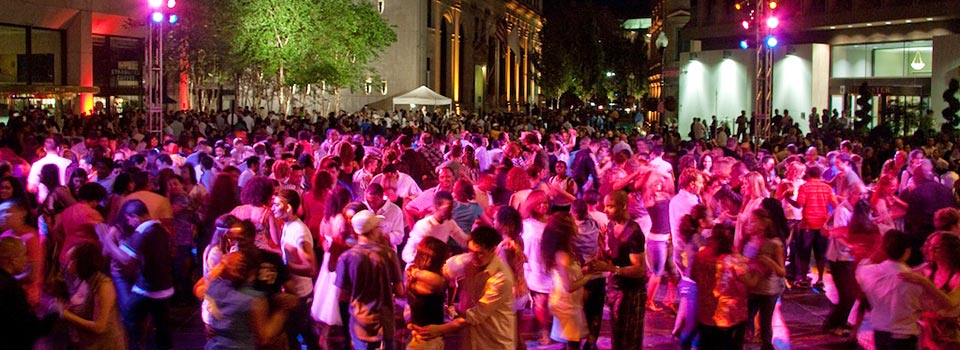
But maybe there's still hope for ballroom.  Maybe it's because I'm getting older, but I’m starting to see more and more people in my age group coming to my classes.  And when I go out and listen to live bands play, my husband and I will often see at least one other couple dancing alongside us.  People are slowly starting realize that ballroom dancing is genuinely fun.  Perfect example: There was this annual town festival that I attended with a bunch of my dance students and friends.  They had closed off the main street of the town to make room for all the food vendors, and an extra-large chunk of street was set up for the DJ and dance space.  Of course the second the music starting playing, my students broke out into a whole bunch of ballroom dance moves.  Apparently we looked like we were having a whole bunch of fun, because large groups of high school students kept joining us to try some of our moves out.  One even mentioned they thought our dancing was awesome, and several asked for my studio’s information.  It felt good to see young people be genuinely interested in learning how to dance.  Maybe one day they’ll recall how fun it looked, and decide to give it a try.  Or maybe not, but let’s hope so.  And if I didn’t convince them, then maybe I convinced you.  Ballroom dancing is fun, and if you’re still skeptical, then I recommend you go out and try it for yourself.  There’s no reason not to.